

Alas, the year 2024 is well underway and so is the general election. Both candidates representing the two major parties are far from being well-regarded by most Americans. Nevertheless, they are the options many of us will choose between on a fateful Tuesday this November.
As we approach the six-month mark until election day, this is an excellent opportunity to assess the current political climate and to make some assessments about the possible outcome of the election. The economy, immigration, and foreign policy will likely be at the center of deliberation for most voters. This article is the first in a series of posts designed to focus on one of each of these three main topics of discussion; it will focus on the economy.
Rightfully so, the economy has been a dreaded topic of discussion amongst democrats when considering Joe Biden for reelection. In the aftermath of the pandemic, the economy was ravaged by inflation, which was primarily believed to be transient until it was not. Years later, many still voice their complaints about the high cost of rent, food, and gas. These complaints persist despite a consistent trend in economic patterns that demonstrate inflation is in the past, unemployment is near all-time lows, and the growth rate is remarkably high, especially when compared to the rest of the developed world. Although my tone may sound cheery, I am mindful of the fact that most Americans do not feel this exact sentiment; it is something that has proven to be illusive for many economists confused by the genuine feelings of the average American despite nearly every economic indicator showing a green light for a healthy economy. However, the economy is on an uphill climb, which may prove to be highly beneficial for President Biden’s reelection campaign.
For many months, the feelings of the average American were exasperated by negative discussions online. By now, most of us have likely viewed a video, whether on TikTok or YouTube, with a younger adult complaining about the cost of groceries at their local store. These videos primarily reflected price increases that took place nearly two years ago. Around two years ago, inflation did hit a multi-decade high, sitting above 9% at one point. Since then, inflation has rapidly dropped, nearly reaching below 3%. At the same time, wages have climbed faster than inflation. From 2019 until the end of 2023, inflation had increased by 20% while wages grew by 23%. In other words, wage increases have outpaced inflation.
The discrepancy in feeling toward the economy versus what was really going on confused me for a while until recently. People are very likely experiencing a version of loss aversion that the field of behavioral economics has discussed at great length. Loss aversion is a psychological phenomenon that explains how people feel a much more substantial impact from loss versus an equivalent gain. In the case of the economy, inflation was perceived as a real loss in economic power. The feeling of that loss weighed heavier and continues to do so for most Americans despite wage growth surpassing the total inflation rate.
People felt tremendous pain from the high inflation rate, which carried significant weight on their perspective of the economy for a lingering amount of time. However, as the economy continues to show signs of growth for an extended period of time, these sentiments will change. It is often said that presidential elections are largely dependent on the economy’s current state, which is largely dictated by the business cycle. Such statements should be taken lightly, but it would be naïve to believe that the economy did not carry a significant impact when deciding who to vote for.
A major indication of this is the consumer sentiment index. According to this survey by the University of Michigan, the average consumer sentiment experienced a sharp decline from early 2020 until a low point in mid-2022. Since that low point, consumer sentiment has experienced a gradual upward trend, indicating that Americans are more optimistic about the economy.
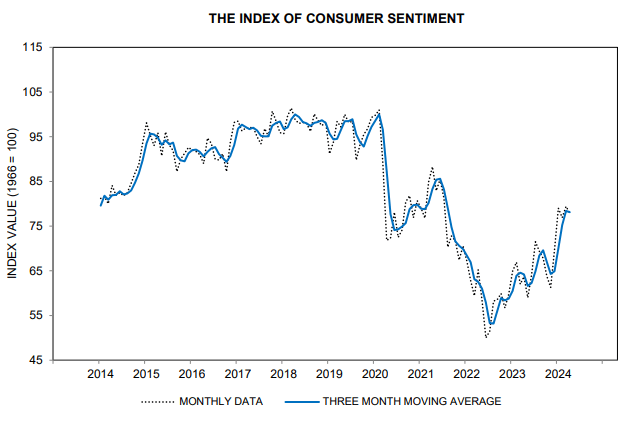
Source: University of Michigan
Given that the economy has shown significant improvement and continues to do so, the presidential election could take a surprising turn as the memory of inflation sinks into the past and the current state of the economy becomes a more pressing thought in people’s heads. With that said, even though the economy has experienced a positive turnaround, there is more to consider when looking at the electability of the incumbent President. However, if the economy is as strong a factor of electability as some claim, the odds are looking better for the President, despite any current polls that suggest otherwise.




 Diametric post
Leave a comment