

Few topics within politics have generated as much interest within the last year as immigration. As such, it will naturally be one of the many focuses of the general election in 2024. On one end, conservatives are demanding increased border security. On the other end, liberals are looking for greater access to citizenship for more immigrants. By the end of this article, I hope to establish a better look at how immigration may impact the election results this year. Based on the research I have done; it looks like immigration will fade away as an important policy concern amongst voters.
As recently as last month, immigration has held the number two position on a list of the country’s top problems, with 28% of the respondents saying it is the most crucial problem today. However, as with any poll/survey data, there is much more to the data, which is why I am taking a deeper look at this information. Another survey, this one by Pew Research Center, shows that a significant portion of those most concerned with immigration come from those who are, or at least lean, Republican. Concern for immigration as a top priority amongst Republicans has risen from 39% of those polled to an overwhelming majority of them at 76% in more recent surveys. At the same time, sentiment amongst Democrats has remained stagnant at around 39%.
Nevertheless, this breakdown goes much further when you look at the actual priorities of each side. A separate report done by the Pew Research Center provides us with a closer look at the concerns on immigration. This report demonstrates a great divide in emphasis between the two sides of the political spectrum. Republicans perceive the border situation as a crisis at significantly higher numbers, about 70%, versus Democrats, among whom only 22% consider it a crisis. Additionally, more Democrats favor a solution that involves increasing resources within the immigration legal system to help streamline asylum applicants or establishing additional pathways for people to migrate legally.
Republicans would prefer to see more resources go toward expanding the border wall that separates the U.S. from Mexico. Some may look at the rising concern over immigration and dispute the idea that it will not be a major factor in the upcoming election. Immigration will not be a primary factor in the general election this year because of the constant ebb and flow in importance of immigration and because, up until now, President Biden’s actions have been reasonably consistent with what Democratic voters are looking to get out of their President.
One only need to look at the headlines on immigrants being sent to sanctuary cities throughout the U.S. and the heavy toll these people are taking on the cities in the form of welfare. Democrats are not against immigration, legal or not, to the same extent as Republicans. Conservatives may fight back against claims they are against immigrants, but they are certainly not in favor of unauthorized entrants to America. It is one of their chief complaints about immigration.
The President did not shy away from challenging Republican complaints about increasing border security. This January, he agreed to improve border security so long as a deal could be brokered to provide money for Ukraine’s conflict; an agreement has not been struck yet. Instead, through actions made by Donald Trump, the Republican party solidified opposition towards Democrats gaining any credit for a win on immigration policy by denying the current administration any sort of agreement on immigration policy, especially any win that would coincide with a win on foreign policy. It was only a matter of time before he began to step up his action on the growing issue. By December 2023, the complaints and number of unauthorized immigrants had blown up to the point it could no longer be ignored or suppressed; action needed to be taken. At one point, it felt as if somebody new was visiting the border daily to show the world just how bad it had gotten. Videos were popping up all over the internet of immigrants riding on trains and entering the country uncontested. There was a lot of back and forth between Republicans and Democrats.
The Biden Administration took a series of steps to help address the ongoing issue of high immigrant numbers coming through the border. For instance, in November, they made a tactical move by sending immigration officers down to the southern border of Panama. The idea was to filter immigrants where the geographic chokepoint is smallest. A significant portion of immigrants were heading north from the Panama-Colombia border and making the 2000-plus mile journey to the American border. Of the two borders, the Panama border is about 211 miles, while the U.S.-Mexico border is nearly 2000 miles long. What this tells me is that the President is looking to address concerns over immigration but in a manner which does not damage him politically.
If the President, for instance, were to shut down the border and simply deport all those who came in, he would likely lose some political favor amongst his constituents. During President Obama’s term, he became infamous for the high number of deportations. Nevertheless, he still managed to be a very popular President among his constituents. I would argue that because of the consolidation of opposition towards Donald Trump, and the strong outcry against his actions on immigrants, that President Biden views it as a poor political maneuver to take the same actions President Obama did when he was in office. As a result, he has made the political choice to address concerns over immigration outside the country. Americans are less concerned about immigrants that are not in America. Diverting resources from America to address the influx of immigrants coming from the South, before they reach the U.S.-Mexico border, could be efficient. In fact, it has been.
In addition to the steps taken to slow immigration at the Panama-Colombia border, the President turned to Mexico to help address the issue by having Mexico increase its border security at their southern border. The results are in, and despite the norm being an increase in migration during springtime, apprehensions at the border have declined between February and March, not to mention there has been an even more significant decline in apprehensions since December. 2024 is only the second year this century that witnessed a decrease in apprehensions between February and March. At the same time, the efforts to address the influx of immigrants south of the U.S.-Mexico border have proven effective. Mexico helped reduce numbers by employing hundreds of its own immigration agents to help solve the issue.
The President’s moves to address the immigration issue seem to have been effective and just in time for the upcoming general election. Throughout President Biden’s tenure, the last three months have experienced some of the lowest numbers of immigrants. January, February, and March all saw less than 141,000 border apprehensions occur. For reference, the highest number occurred just before these months, when December 2023 saw nearly 250,000 border apprehensions. Meanwhile, Mexico’s border apprehensions experienced an all-time high in January and February when they stopped almost 120,000. These numbers go to show that a significant number of migrants have been stopped before coming to the U.S.-Mexico border.
So long as this trend continues, the recent memory of hordes of unauthorized immigrants infiltrating the country may be well in the past by the time the Presidential election occurs. By November, the immigration issue may present itself as less of a problem in the eyes of the public. Another factor to consider is the differing perspectives of the two parties.
Given that most of the concern for the border is coming from the Republicans, immigration may not be much of a factor when voters enter the poll booths this fall. It is unlikely for Republicans to vote for the Democratic nominee, and his actions to address the border will not change their opinions of him either. With that said, it is my impression that immigration will play a minor role in the outcome of the presidential election. Since the point of this article is to determine the impact, if any, that immigration policy may have on the election, it is essential to take a realistic view of the likelihood that Republican or Democrat voters would alter their vote based on the actions of the Biden administration. However, such a statement is more of a reflection of the political polarization that continues to paralyze American politics than of immigration policy itself.
To get a better idea of how immigration may play a role in the general election, it is important to look at how independents feel about the issue. A poll done by PBS shows a decline in how people feel about immigrants. In 2021, 66 percent of Americans were in support of being open to people around the world. This number declined to 57 percent in recent months. However, again, the numbers are heavily skewed one way or the other, depending on the party. Only 27 percent of Republicans are open to people from around the world, while 84 percent of Democrats are. An important discovery is that 55 percent of independents favor openness in America. This means there is a slight lean towards democratic ideologies amongst independents in this one poll.
In addition, the same poll found that 44 percent of independents believe increased border security should be a top priority to address the immigration issue. As revelatory as these statistics are, it is important to point back to the ongoing trend in immigration. This poll was done around when the border crisis was at its height, late January, a month after the peak numbers in December. So, again, the issue had become public to the point that it was a pressing issue for many Americans, but the extent to which this is so will decline over time. However, the decline of immigrants flowing to the country will result in a net positive benefit to the Biden administration.
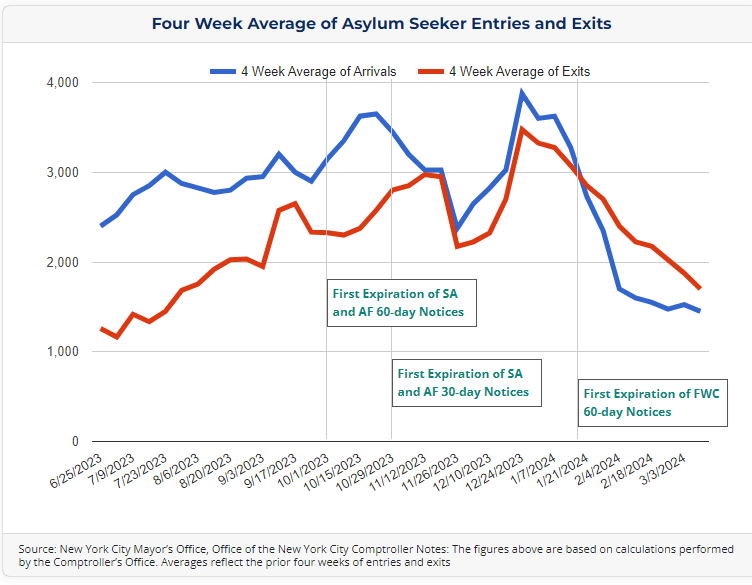
In an interesting turn of events, immigrants were being shuttled to the heart of democratic territory. Have these efforts to bring immigrants to designated sanctuary cities produced any negative sentiment amongst voters? Many democratic cities, particularly New York City, began pressuring the Biden administration to reduce immigration numbers. Despite the challenges the city faced with the need to care for 100,000 plus immigrants in the city, the comptroller of New York City released a “Facts, Not Fear” report designed to curtail the formation of any myths surrounding immigrants. Efforts by the city to lower the number of immigrants coming into the city have been effective, based on the below image.
Immigration as a policy concern amongst Americans may not have the same main staying influence as economics, but it tends to ebb and flow among the top priorities and then fades away as a chief policy concern over time. This was not the first surge in immigration, and it certainly will not be the last. However, the issue has become increasingly polarizing between the two parties, and any efforts to change the current system have come mainly from executive action due to the inability to get much done within Congress.
Given the polarizing nature of the topic, there is a low likelihood that opinions from either side are likely to alter by much. In addition, given the ebb and flow nature of immigration as a concern and the heightened concern that came about as the flow of immigrants increased, unless there happens to be a resurge or something drastic occurs, the elevated concern over immigration will likely decline.
As I have already discussed, recent efforts to reduce the flow of immigrants into the country have proven effective. The number of border apprehensions has decreased in America while increasing south of the U.S.-Mexico border. For now, the surge in migration has been reduced. That does not mean the perception of immigration as an issue has declined, however. As the number of immigrants coming into America continues to decline, we are likely to see immigration as a top priority fade from the political arena. With just over six months left until the Presidential election, there is still time for things to change, but as of this moment, things are looking bright for Biden regarding Immigration policy.



 Diametric post
Leave a comment